Sunday, 8 October 2017

Shetland ... Pallas's Grasshopper Warbler ... Red-flanked Bluetail ... Little and Rustic Buntings ... and more !

A somewhat wet and windy week on Shetland with the excellent Paul French produced some great birds ...

The stand-out bird in terms of good views was this Red-flanked Bluetail at North Roe on 6th October ... a day that was also memorable for its absence of rain ... the bird perched obligingly on a twig only a few meters away ...


... before flying a short way ...


... revealing the blue tail ... then perching in thicker twigs to reveal the flank and tail colours together ...


... not every bird was as showy as this one and unsurprisingly the Pallas's Grasshopper Warbler at Collafirth on 1st October was one case in point ... it lingered in a dense iris bed and sometimes moved through grassy tussocks to give obscured views ... and then performed several flight circuits of the small valley when the cinnamon underparts, rufous rump and white tips to the tail feathers showed well in the last few minutes before the heavy rain arrived ... it was admired by a fair crowd ...


... after arriving at Sumburgh on 30th September , a wander around the farm area produced Goldcrests and Bramblings and a warbler in the quarry was attracting some attention from the possibly over-enthusiastic birders ... we were on Shetland so it MUST be a Blyth's Reed , or was it ? 


... no supercillium on front of the eye, too great a primary projection and emarginations extending only to P3 showed on the images and gave three final nails in the coffin of Blyth's ... it was a Reed Warbler ... but an educational bird nonetheless ...

... such was the level of expectation that birds that normally attract welcome attention hardly warranted a second look ... Twite were all over the place ...


... sub-species are always good though and Shetland Wren certainly did not disappoint ...


... T.t.zetlanicus ... a much darker and longer-billed form than the nominate race ... 

A Great Grey Shrike was at Dale of Walls on 1st October ... while never giving very close views, it was constantly active ... having caught what looked like a shrew, it lardered the prey in some wire ...


... then immediately resumed foraging ...


... we all need a little luck and as we drove into Melby as the rain came down a Rustic Bunting was feeding on the side of the road ...


... hopping right out in the open ... we hardly got wet at all ...

... a small group of Common Redpolls were in some trees as we continued around Mainland Shetland ...


Before heading for the ferry which would take us onto Yell and then to Unst we ventured out to the far NW point at Esha Ness ... it was a truly wild morning with frequent showers coming through on the force 10 gale ... quite remarkably a Little Stint was feeding in some small pools ...


... and a single Snow Bunting flitted by the edge of the cliff ... several Ruff foraged and flew around ...


... and a faeroeensis Snipe kept low ...


... some Greylag Geese looked edgy against a dramatic backdrop of sea stacks ...


A putative Siberian Oystercatcher had been reported at Sandwick ... the tide was right in leaving no exposed beach and the small Oystercatcher flock was on a nearby hilltop ... the bird showed an increased amount of white in the closed wing but the nasal grooves were hard to assess as the gale buffetted us around ...


... it certainly had a brownish cast ...

Some Crossbills started to be reported and after waiting a while in the lea of the pine plantation at S.h.e. a female perched obligingly on a top branch ...


... later on a lovely male finally showed as it fed quietly among the lower branches ...


The headland at Skaw offered little shelter and a Red-throated Pipit there gave brief views among the tussocks ... a Lesser Whitethroat showed a brownish cast to the mantle - probably a blythi ...


... and a small number of Bonxies were still around ...


... a single juvenile Sanderling fed on the beach ...


At Halligarth a sheltered spot provided nice feeding for some common migrants and nice viewing for us !
... Spotted Flycatcher was confiding ...


... as was a female Redstart ...


The fields at Norwick near to Valyie were attracting birds among which was a flighty and elusive Little Bunting that would often fly over calling and disappear into deep vegetation ... it did eventually perch on a building just long enough to give some nice views ...


Ever-present were Shetland Starlings with their tantalising calls that seemed to mimic almost anything ...


After a few sightings of elusive Snow Buntings we found one in a small quarry - a lovely male of the nominate race ...


At Mossy Hill another of the seemingly ever-present species cavorted in typical Raven style ...


And on the choppy waters of Easter Loch a female Ring-necked Duck associated with a group of Tufted Ducks ...
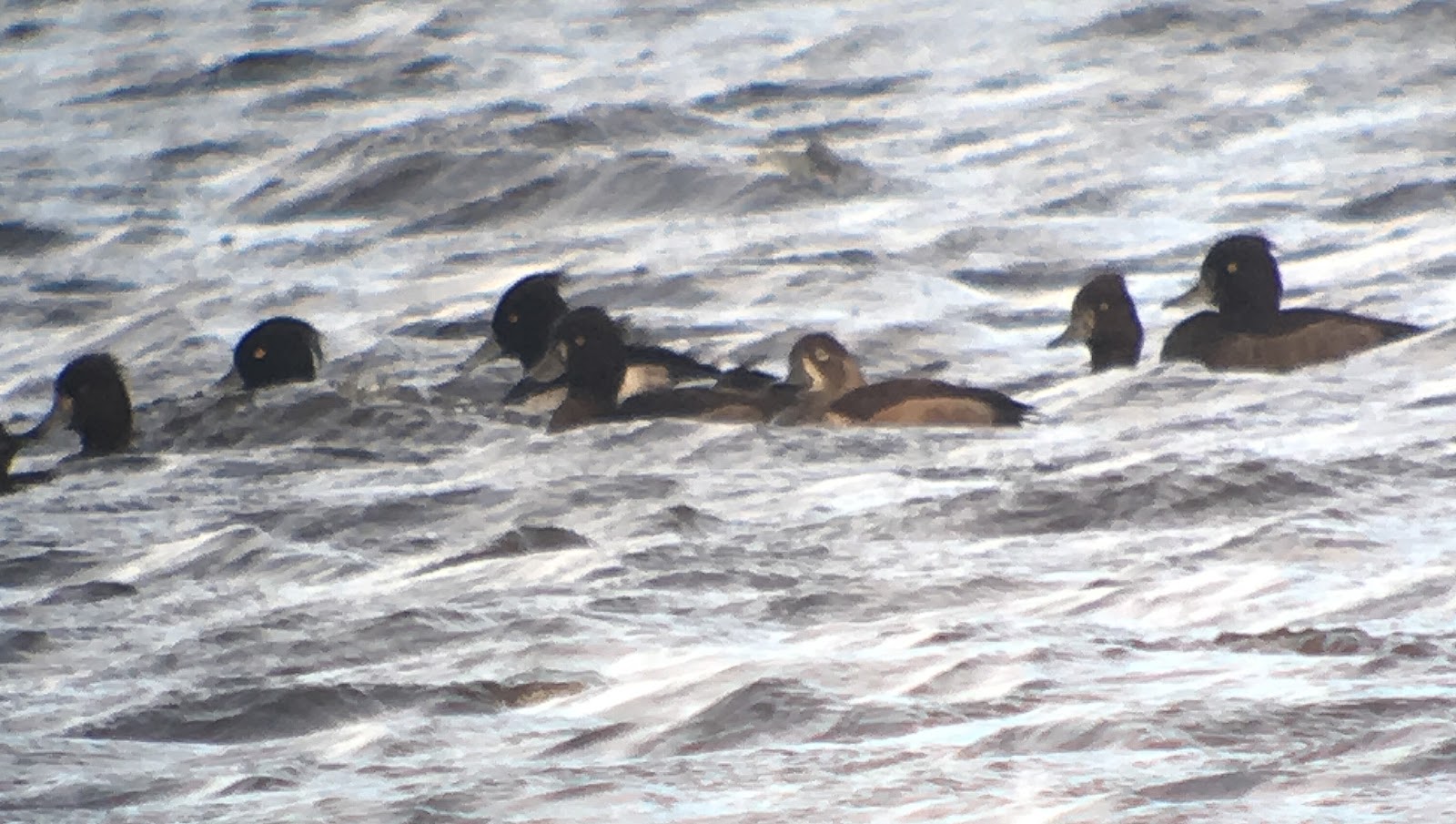

... while out at sea in a sheltered bay there was a very distant Slavonian Grebe along with Black Guillemot ...


With our time on the islands running out we fruitlessly searched a pool at Gruness for a Buff-bellied Pipit that had been present earlier ...

... a dark grey-brown Continental Song Thrush perched among the rocks ...


... and a Chiffchaff fed out in the open on the short turf ...


Sunday, 24 September 2017

Birds and Books ... The Wigtown Book Festival ... Loch Ryan and around ...

The only shelter to be had at Loch Ryan was by Bishop Burn ... thirty-nine Red-breasted Mergansers had got the picture ...

The males were all still in eclipse plumage ...


... some displaying ...


... The Wig was a different story with the wind whipping up the waves and the birds taking shelter ... a group of Eiders was on the end of the point ...


... where a first-winter Mediterranean Gull had just taken off ... a Sandwich Tern battled against the wind and a small group of Dunlin and Turnstones and a single Sanderling fed on the shore ...


... most of the Dunlin were showing mixed-generation scapulars as they acquired winter plumage by degrees ...


... on the more sheltered south side of Wig Bay a solitary Slavonian Grebe showed intermittently between the crests along with another ten Red-breasted Mergansers ...


 ... still in breeding plumage ...

... Meanwhile in Wigtown the early stages of the Book Festival were taking shape ... this event really takes over the town and the whole place is buzzing ... they do it really well and the bookshop/cafes serve up excellent food and good coffee ...

... the sheer number of books is quite phenominal, mainly second-hand but with a few new books ... I was tempted by a set of Witherby's Handbook for £30 before discovering that this is the going rate ... when I checked the price just a few years ago it was £100 ...

... I did come away with this however ...


 ... which I've just dipped into, but it looks promising ...

Patrick Barkham spoke with unpretentious eloquence and showed his formidable intellect in answering a tricky question around the relative merits of Brexit and small islands  ( complicated stuff ) ...

And the Craft Tent had a few tempting goodies ...


... but why Canada Geese ? I wondered ...

Back along the coast near the Isle of Withorn, this time in sunshine, and groups of Shags loafed on the rocks ...


... along with the occasional Cormorant ...


... while some very flighty Wheatears perched always just a little distantly ...


Wednesday, 6 September 2017

To Druridge Bay in search of waders ... the highlight ... a Black-necked Grebe ...

Waders at Druridge Bay were unremarkable and elusive on Monday with Cresswell Pond having only a few Lapwings : the Budge Pool wasn't much better on arrival although four Ruff and a hand full of Black-tailed Godwits dropped in.  Around thirty Dunlin made an appearance but an enthusiastic although eventually unsuccessful juvenile Peregrine kept them mobile.

Then on to the main pool at Druridge with expectations running rather low ...

... along with two Little Grebes was a Black-necked Grebe ...


... initially at the far side of the pool, it came much closer ...


... it spent some time diving but also had a go at 'snorkeling' a behaviour I have not seen before in this species ...


... some turns of the head showed the typical rounded crown in front and rear aspects ...


... a rare treat to see a winter plumage bird at this time of year in northern England ...


... with a British breeding population of around 50 pairs, Northumberland features as the most northerly regular site although one pair bred in Scotland in 2014 ...

... many passage birds in autumn are thought to be of continental origin and most head further south to winter from Iberia across southern Europe to the Mediterranean and Black Sea coasts ...

... the greatest numbers of wintering birds gather in the south Caspian Sea with hundreds of thousands birds present ...

... the British wintering population is around 120 ... ice-free locations such as the London reservoirs are favoured sites ...


Saturday, 26 August 2017

The Workington 72 ( Med. Gulls ) ... one ringed in Ireland ... two in Belgium ...

The yellow-ringed bird had been ringed in Dublin on 1st September 2014 as a juvenile. It was seen again in that area about a week later but not subsequently.  Med. Gulls have bred in Wexford in small numbers since 1996 but the ringer tells me that they do not breed in Dublin but are known to come there in the winter from France, Belgium and The Netherlands.

This bird was next seen on 9th May 2015 at NSG Teufel und Pfaffensee.  This is a former coal mining site that has been extensively restored as a wetland and lies 35km north of Frankfurt.

The next time this bird was reported was in the company of 71 other Med. Gulls at Workington ...


... the other two ringed birds carried white rings and had both been ringed in Belgium at a nesting site in May 2017.  One was a 3CY (2ndS) bird and the other an adult ...


... part of the flock including some Black-headed Gulls and juvenile Lesser Black-backed Gulls ...

... the Med. Gulls have a liking for standing in the seaweed and only occasionally wandering up onto a rock to reveal rings ...


Thursday, 24 August 2017

The Leighton Moss Purple Heron ... an unexpected treat ...

Present on the reserve for its seventh day this wonderfully elegant juvenile heron gave great views in front of the Grizedale Hide this morning ...


... and then some lovely flight views ...


Workington Mediterranean Gull Fest ... 72 birds there of different ages ... 3 colour-ringed birds ...

The numbers of Mediterranean Gulls present in the Workington area in late summer have been gradually building over recent years ... the flock of 72 at Workington Harbour a few days ago was the greatest number I have seen together in the area ...


... two juveniles  ... two second-winters ... and some adults in flight ...


... this group, mainly adults show quite variable head patterns ... one has a yellow colour-ring ...


... these three are at different stages of moult, going from juvenile into first-winter plumage ...

... interestingly, colour-ringed birds occurring previously have come from a diverse range of countries ... Hungary, Poland, Germany Belgium ...  do they arrive here independently or do they congregate somewhere on the continent first ?


Wednesday, 16 August 2017

Black-tailed Godwit at Campfield Scrape on 3rd July ... ringed at Montrose Basin on 28th Sept 2015

The Montrose Basin in Scotland is the most northerly regular wintering site for Black-tailed Godwit ...
one of a group of ten birds that I photographed at Campfield Scrape on the Cumbrian Solway on 3rd July was colour ringed at the Montrose Basin ...


... the bird had been seen on ten other occasions ... all at the Montrose Basin ... ( click on image to enlarge )...


Raymond Duncan, the ringer has provided some interesting information about the movements of these birds ...