Tuesday, 3 January 2017

Antarctica

Following on from our unexpected encounter with Emperor Penguin we set out to land at a number of sites on the Antarctic mainland, nearby islands and on the ice shelf itself ...


Adelie Penguins were well into their breeding cycle ... some were nest building ...


... others had eggs ...


... they utilised the available flat ground while Antarctic Cormorants inhabited the steep slope above ...


... this species already had some chicks hatched ...


It was interesting to see some of the pelagic species on their breeding grounds.
  A Wilson's Storm-Petrel was flying around a high rocky slope and entering a nest hole between the rocks ...


... a Snow Petrel was visible at its nest site between a large boulder and the snow slope ...


... Gentoo Penguins also had chicks ...


... and a Chinstrap Penguin wandered by ...


... it seemed fitting to see Snow Petrel flying over brash ice ...


There were a few Kelp Gulls including some of ages other than adult ... this third summer bird showed nicely ...


Having retreated from the Weddell Sea north west along the Antarctic Sound we landed the following morning on Half Moon Island where a confiding Brown Skua was capitalizing on the regurgitated stomach contents of a recently beached seal ...


... Chinstrap Penguins were breeding on some of the rocky promontories amid the snow and forming nervous groups prior to heading out to sea ...


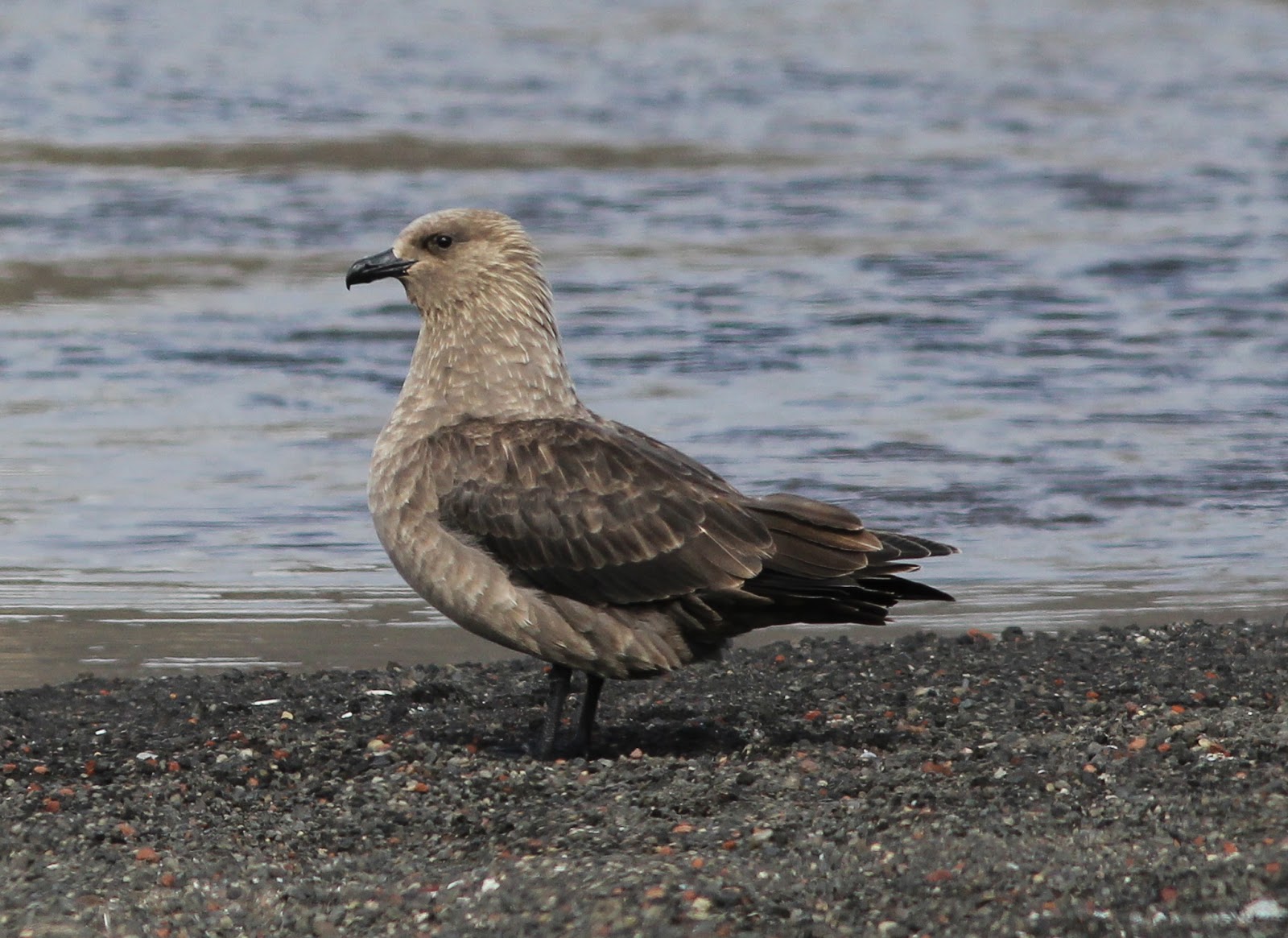
Deception Island is a caldera and the ship made its way into the vast lagoon formed by this still active volcano ... we landed at Whalers Bay where much of the land is free of snow by virtue of the heat from volcanic activity.  A pool at the top of the beach was attracting skuas ... this Chilean Skua was somewhat out of range ...


... the rufous tones showing well in the lovely afternoon light ...

... also present were some South Polar Skuas and this pale morph bird was a classic example ...

... but to add further interest a dark morph South Polar Skua raised its wings to show the solid blackish under wing coverts ...


... and its smoky black/brown breast contrasted with the mottled brown breast of the accompanying Brown Skua to further confirm its identity.

... while high on the cliffs above a Cape Petrel circled around its nesting site ...


The following day dawned ... although in these latitudes during summertime  dusk blends into dawn ... misty and grey with snow flurries in the air ... we cruised the Gerlache Strait in Zodiacs and came upon a very somnolent Leopard Seal on a small ice flow ...


... this was our second Leopard Seal - a species renowned for predating penguins ... we had observed the nervous behavior of penguins repeatedly as they formed small groups on the shore before finally committing to heading into the sea and also watched them dashing for shore under water ... but at no time did we see any predator targeting penguins ...

... along the edge of the ice shelf a group of Antarctic Cormorants swam and head-shook in synchrony ...


... small groups of Gentoo Penguins stood around on the ice shelf ...


... and quite remarkably we then came across another Emperor Penguin on the ice shelf ...


... this was an immature bird with whitish auricular patches ...


... its presence attracted the attention of a Gentoo Penguin ...


Gentoo Penguins were breeding on the land adjacent to the ice shelf on areas where the rock protruded from the ice piedmont ...


Monday, 2 January 2017

South Georgia to Antarctica

After the wonderful experiences of landscape and birding on South Georgia it was nevertheless good to be back on the ocean and heading south west toward Antarctica.
So once more onto the bridge ... and with great results !
Having become quite familiar with Antarctic prions the next prize would hopefully be Blue Petrel - a small prion-like petrel.  We scrutinized every passing prion in the hope of picking up that tail pattern - a white tip and lacking a black terminal band ... late afternoon on 28th November we got lucky ...


... and soon there were more and we rapidly started picking them up on their largely white undertail pattern and grey / black crown and nape ...


... an Antarctic Prion followed these two Blue petrels.

A few Black-bellied Storm-Petrels fed ... flying delicately over the sea surface ... and showing their minimal foot projection beyond the tail as compared with the long foot projection of Wilson's Strom-Petrels ...


... and as the wind speed gathered more Blue Petrels and Antarctic Prions shot through ...


... in the now dull light and with the wind having reached storm force, the occasional diving-petrel made a brief appearance.  A few stalwarts huddled on the port bridge-wing to witness what became a steady stream of these Little Auk-like birds.  The genus Pelecanoides comprises only four species and is itself the only representative of the family Pelecanoididae.  With the benfits of digital photography we were able to discern the features shown by two distinct forms.  Common Diving-petrel was the most common and showed a dusky under-wing, smudgy face pattern and plain upper-wing and mantle pattern ...


... it became apparent that a few of the diving-petrels looked rather different - they had pale under-wings, a contrasty face pattern and had pale scapular lines and pale tips to the upper-wing coverts  ...


... these features are consistent with those of Georgian Diving-petrel.

Another two days at sea lay in store and it was another early start the following day ...
this time the highlight was Southern Fulmar ...


Fulmars are great birds and Northern Fulmar - Fulmarus glacialis - as its specific name implies frequents the high latitudes of the northern hemisphere.  Southern Fulmar - Fulmarus galcialoides ( another icy name there ) - frequents the cold waters of the Southern Ocean.
This was a species that I was particularly keen to see ... alive !  When Bob, my travelling companion,  and I were in NSW Australia we found a tideline corpse - only the third record for NSW ( the previous two also being corpses ).  I had subsequently searched for Southern Fulmar on a pelagic off Capetown - but with no luck.
So this was great !


The bill is a striking affair with neat black tip, otherwise pink but with a blue tube ...


... the rump is white ...


... and overall a more striking bird than Northern Fulmar ...


Not every bird was photographable and our second Kerguelen Petrel made an equally rapid getaway to the first one.

On the following day we had our second White-headed Petrel - a stunningly beautiful and elegant pterodroma which had put in an all too brief appearance earlier ...


... this time it was different and the bird made several passes of the ship - demonstrating its typical pterodroma flight mode ...


Another Antarctic Petrel joined the ship the next day and unlike its consorting Cape Petrels made repeated high arcs over ship ...


Later in the day Elephant Island came into view and we paused for a time to gaze at Point Wilde and wonder at how Shackleton's men could have survived there so long - and in winter time ...


... our first Chinstrap Penguins were in the sea .. porpoising with great verve ...


A very different landscape revealed itself with the sun already high at around 5am on 2nd December.  We were within sight of the Antarctic peninsula and were making our way south east down the Antarctic Sound towards the Weddell Sea.  Ice flows, icebergs and brash were all around.  Adelie Penguins were on many of the flows ...


... and rushed to return to the water ...


... one large ice flow had a much larger bird along with the Adelie Penguins ...


Emperor Penguin !!!

... this species is rarely see away from the breeding colonies in more inaccessible parts of the Antarctic Continent ...


... the yellow auricular patch shows this to be an adult ...


... an Antarctic Cormorant flew over ...


... and a Sheathbill posed well with a bill suggestive of ... well probably best not to think where that's been ...


... and more Adelie Penguins porpoised ...