Wednesday, 23 October 2019

A good week on the Isles of Scilly ...

Having read about the exciting rarities and rarity events on Scilly over many years, it was all the more satisfying to finally visit the archipelago ...

As the Scillonian prepared to leave Penzance Harbour on 12th October an eclipse male Eider was busily catching crabs nearby ... this is apparently a scarce species in the area but this individual has been regular there recently ...


... as the boat approached St. Mary's a Yellow-billed Cuckoo was reported as showing in the Dump Clump ... it turned out to be a rather elusive individual but eventually perched up in distant sallows for a time before again dropping out of sight ... a Spotted Crake moved through dense vegetation just next to the nearby boardwalk ...

... in the Old Town Churchyard a Red-eyed Vireo performed lively fly-catching manoeuvres ... another bird to allude the camera ...

The next day we visited The Garrison where another elusive bird - a Blue Rock Thrush - finally gave some nice views as it fed at the base of the cliff and on the rocks at the top of the beach ... looking out to sea Shags were a constant presence moving around the coastline ...


... at Newford Duckpond the putative female Green-winged Teal was posing to give the sort of views that Teal rarely give ...


... this was arguably the most interesting bird of the week and seemed to show many pro-Green-winged features...
... the head pattern was notably well-marked
... the anterior wing-bar was distinctly cinnamon at the proximal end
... and the feature which is now considered to be a 'silver bullet', i.e. of the extent of the black stripe on the outermost tertial ( not extending to the feather tip ) fitted also ...

Less contentious was a female Blue-winged Teal on Porth Hellick Pool ... this bird had the reputation of inhabiting the reed-bed most of the time but showed really well on both our visits to the pool ...


... some Greenshanks flew by and on the beach a Kingfisher flashed by the point ...

The following day we crossed to St Martin's to look for a Rose-breasted Grosbeak ... this bird turned out to be another elusive individual ... it was seen at the Bakery, the Quarry and the Cricket Pitch ... it put in brief appearances at each of these locations but remained hidden for long periods of time in between ... the upshot of this was that most people failed to see the bird but learned that chasing it to its last location was a bad strategy ...
... meanwhile a pair of Ravens provided some light relief as they flew by ...


... and three Snow Buntings passed overhead ...

The next day ... and back to Old Town Churchyard where the Red-eyed Vireo gave some better views in the clam of the morning sunshine ... and a juvenile Red-backed Shrike perched obligingly in a nearby hedge ...


... two Pink-footed Geese were an unexpected sight ...


A White-rumped Sandpiper was on Toll's Porth Beach and gave unusually good views as it fed languidly on the deep sea-weed at the top of the beach ...


After our relaxing day on St. Mary's catching up with those aforementioned rarities and scarcities, it was back to St. Martin's with the elusive Rose-breasted Grosbeak and a new strategy in mind ... a prolonged stake-out at the Quarry eventually paid off as the bird perched briefly then flew right across in the direction of the Bakery ... it then gave much better views behind the Bakery as it perched in two separated locations before heading once again into the dense area of bushes ...


... undoubtedly a spectacular looking bird with its bright red under-wing coverts and striking head pattern, delicately rose-tinged breast and blackish wings with white spots ...

Then back on St. Mary's the next day the fields were quiet and the beaches yielded only a few White Wagtails and a scattering of rather attractive Northern Wheatears ...


On our last full day it was back to the Dump Clump for a patient wait where a Red-breasted Flycatcher showed briefly and a Yellow-browed Warbler tantalised in the thick foliage ...


... at Porth Hellick Pool the Blue-winged Teal was again feeding in the open and some Common Snipe lingered nearby ...


Wednesday, 2 October 2019

More Geese arrive on the Solway ... while inland at Geltsdale two Divers make a surprise visit ... birds are on the move ...

Over the past week more waves of Pink-footed Geese have headed south over the Solway ...


... while in recent days the first Barnacle Geese announced their presence in the skies with their barking calls ...


... more subtly thereabouts were the constant calls of migrating Skylarks overhead ... many invisible against the blue sky as they passed over high ... but some lower birds could be seen ...


... Little Egret numbers continue to boom and flybys have become commonplace ...


But waders are prominent in the mix ... with Redshank dominant in the bay at Port Carlisle ...


... and some groups of Knot within the flock ...


... more in line with hopes and expectations were a group of three Greenshank at Glasson Point ... 


... where a fairly late Common Sandpiper called twice as it flew in to feed on the exposed mud ...


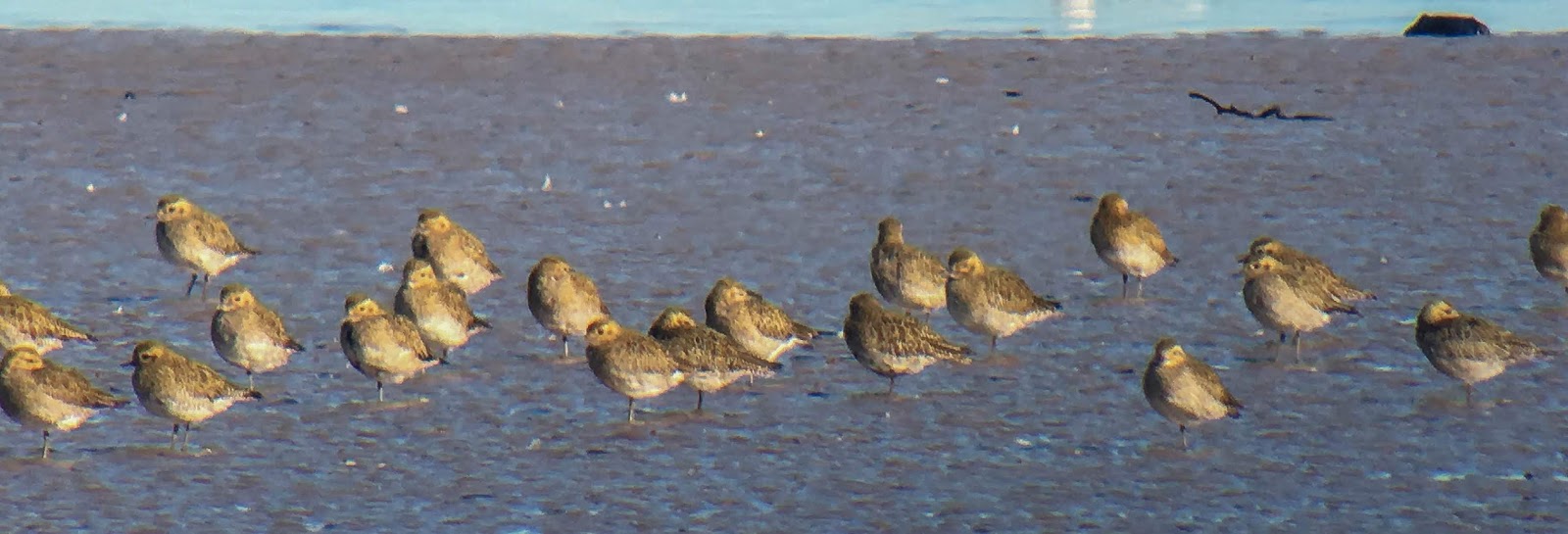
... and two hundred Golden Plovers certainly looked 'golden' in the warm autumn sunshine but none looked to be anything other than Eurasian Golden Plover despite close scrutiny ...


An adult Spotted Redshank was on the back of the small island at Port Carlisle over the low tide ... but wandered out of view to evade the camera ...

While expectations normally run relatively high on the Solway ... it turned out to be Tindale Tarn where the most interesting birds turned up recently in the form of an adult Red-throated and a juvenile Black-throated Diver ... it was the first occurrence of both species on the tarn and a particularly nice chance to see a Black-throated Diver locally ...


Interestingly the Red-throated Diver represented the more unusual record for an inland water.

A juvenile Scaup was also present on Tindale Tarn recently.


Near the Tarn some Meadow Pipits perched on wires and gave good views of the impressively long claw on the hind-toe ...


... and in my garden a Sparrowhawk peers hopefully at the garden feeders ...


Monday, 16 September 2019

It's Autumn ... The Pinks are back ... Some Waders too ...

In the misty morning light on the Solway the air was still and the sound of Pink-footed Geese came time and again as flocks made their way southwards ... some flocks of around fifty birds ...


... while others passed high over Anthorn in small groups ...


... sometimes there was only the sound of their calls to indicate their presence ...


On the Wampool at Anthorn with the tide well out there were flocks of Lapwing and Golden Plovers on the exposed mud ... and two Ruff associating loosely with the other waders ...


... a little downstream a group of four Black-tailed Godwits fed on a sandbank ...


... and an adult Mediterranean Gull was nearby with some Black-headed Gulls ...


Among the big flocks of Redshank at Port Carlisle was a scattering of Knot with some lovely looking juveniles ...


... one of two Greenshank frequented a shallow pool there ...


And over the high tide at Campfield a Great Skua came along the shoreline and was pursued briefly by a juvenile Peregrine before both disappeared as quickly as they had come ...


Tuesday, 10 September 2019

The Lancashire Fluke Hall Wheatear ... identification still unresolved ...


With a brisk cool wind blowing the wheatear was sheltering beneath a rock when we arrived on site on the first day that it was reported ...


... originally being identified as either an Eastern Black-eared or Pied Wheatear, opinion swayed in favour of Eastern Black-eared on that first day ...

After a short while the bird emerged and gave nice views as it perched on large rocks ... but always returned to near its favoured sheltering place ...


... here it shows the broad slightly rusty breast band and white throat suggestive of Black-eared ...


... the mantle and scapulars show a degree of pale fringing , suggestive of Pied ... but still some overall rusty tones - certainly not predominantly grey ...


... flight views probably add little and tail pattern is similar for both species ...


... the light was variable with intermittent sunshine and also some duller periods ... the colour tones changed to a degree with the light changes ... nevertheless it never looked purely grey ...


Opinion has subsequently swayed in favour of Pied ... some however remain convinced that this is an Eastern Black-eared Wheatear ...

Some faecal samples were apparently taken ... hopefully DNA analysis will give some definitive answers ...

... time will tell ... or will it ? ... is a hybrid possible ?