Wednesday, 27 February 2019

To Dungeness in search of interesting gulls ... in the hope of Caspian Gull ...

While in southern England I hoped to expand my knowledge of Caspian Gulls ... I have had very limited experience of this species - several times on Teesmouth and a few times in the Midlands ...
Having seen reports of Caspians at Dungeness I spent a little time on the rspb reserve where the gulls were on distant islands ... but the beach by the fishing boats seemed to offer the potential for better views ... half a dozen loaves of sliced bread later brought around a hundred Herring Gulls and a single Yellow-legged Gull ... the bright sunshine was very nice but no help to the gull-watcher ... the gulls bobbed about on the sea and were reluctant to stand obligingly on the beach ...

There were some groups of gulls loafing on the broad shingle strip between the road and the beach ... quite flighty and mostly sitting down before taking off in one seamless motion from sitting to flying without the transitional 'standing' phase that I was hoping for ...

After some careful approaches that often resulted in a whole flock just flushing ... one group was losing individuals more steadily as each bird flew off ... from the middle of this flock one bird caught my eye ... the very pale underwing was striking and suggested Caspian Gull  ... it flew past me and kept going and was finally lost to view distantly somewhere near the lighthouse ... with the sun behind me I took a series of flight shots ...


p9 and p10 have almost pure white extensive tips with only tiny black marks ... p8 on the near wing is missing but the far wing shows pale tongues intruding into the black on the wing tip ...


on the near wing p5 shows a narrow black marking ... as the sun catches the underside of the far wing it appears very pale ...


again the pale tongues on the far wing show well ...


the deep chested structure becomes visible ...


the eye looks dark and the bill is greenish pale yellow with a hint of some dark marking ... all good features for Caspian Gull ...


the almost entirely white tips to p9 and p10 on the near wing and narrow black band on p5 show here ...


the head and neck show no sign of streaking ...


with the bill now in profile the lack of gonys angle is apparent ...


as a Herring Gull comes into shot the longer narrow wing of the Caspian Gull is highlighted along with its paler underside ... the difference in body shape is striking ...


... zooming in on the Caspian ... now looking suitably beady-eyed ...


... and on the Herring ...


This was a very different experience of Caspian Gull from those that I had seem previously but very rewarding ...


The Dungeness rspb had a lovely male Smew ... my first male of the winter ...


... and as I walked in the warm sunshine along the track between gorse and bramble scrub a Dartford Warbler flew right across in front of me and disappeared into the tangle ...



Friday, 8 February 2019

My Birding Week ... Some Highs - a Rare Warbler ... and Lows - the Complexities of Bird Recording ... and the Mixed Fortunes of Surveys ...

When I became resident in Cumbria and joined the Cumbria Bird Club in the 1990s we submitted records on little cards ... rather time consuming but quite open to free expression.  Then came the Recording Template where records were entered on an XL Spreadsheet ... it felt a little less personal but must have made life a lot easier for the Regional Recorders and County Recorder of the time ...

With the new Millennium came a flood of new Social Media features ... Facebook, Twitter and Yahoo Groups ... and the birding community gradually took up the chance to use these as means of sharing birding information in a very immediate way.  That all seemed very good ... and it was !

The world had moved on ... but there were those who did not ... and as the Regional Recorder for the north part of Cumbria by the second decade of the millennium I was getting an array of records ranging from XL spreadsheets to hand written narratives ... rural vicars would refer to 'the parish' ... I wondered just exactly where they meant ?

And then as the decade progressed those new social media platforms that had served a very good function as informal methods of information sharing somehow turned into accepted reporting channels ... there grew an acceptance within the Bird Recording network that we really had no choice but to accept records in whatever shape they came ...


BirdTrack  ... what a good idea !  And it is ... with its sophisticated mechanisms like the setting of Validation Thresholds whereby we County Recorders are supplied with descriptive details of species designated as ' Locally Rare ' ... what could possibly go wrong ?  The answer to that now seems so obvious ... it is so easy for observers just to ignore that request for descriptive details ... and they do, most of the time ...
But there was a way round that because we County Recorders got lists of contact details for observers so we could get in  touch with them and ask them nicely for details ... but that was alright until the Data Protection Act ... so now we can only message through BirdTrack and observers just get another message to ignore ...
And BirdTrack now take records from BirdGuides who probably took them from BirdingCumbria who probably gleaned them from Twitter or Facebook ... the circularity of this makes it increasingly difficult to track back to the original observer ...

So dealing with that probably goes down as a Low in my week ... but getting out in the field is almost always an antidote and delivers some Highs ...

As I did my WeBS count at Talkin Tarn I watched Black-headed Gulls following feeding Coot in much the same way as I had seen Wigeon doing there ( Blog post 20 March 2018 ) ... a seemingly strange strategy on the part of the gulls which did not seem to derive much benefit from this ...


... they watched the feeding Coot intently as the Coot brought potential food material to the surface and occasionally picked up an item in their bill while never apparently feeding on these items ...
... Quite good on the 'Highs' scale I think ...

The Cumbria Bird Club Long-eared Owl Survey runs through February and March ...


... of my seven sites I have visited three so far as I wait for evenings without wind or rain ( which is a bit of an ask in Cumbria ) ... no Long-eared Owls so far but flyover Woodcocks and Common Snipe were quite magical as I waited listening for distant sounds ... less magical were the late dog walkers with their less than friendly muts ...
... some definite Highs there but a few Lows to boot ...

And finally on to the undisputed Highs ... a mid-week visit to some woodland next to a Water Treatment Plant near Fishburn Co.Durham where a Pallas's Warbler was being reported ... albeit described as 'elusive ' ...
... the area next to the WTP perimeter fence was alive with birds in the weak winter sunshine ... Goldcrests and Long-tailed Tits feeding in the pines and low bushes ... and after a few minutes a smart Firecrest showed ... at least two Chiffchaffs were present .   the first looked like collybita although the light was tricky and views were imperfect ... then another perched out on bare twigs and was surely a good candidate for tristis ...
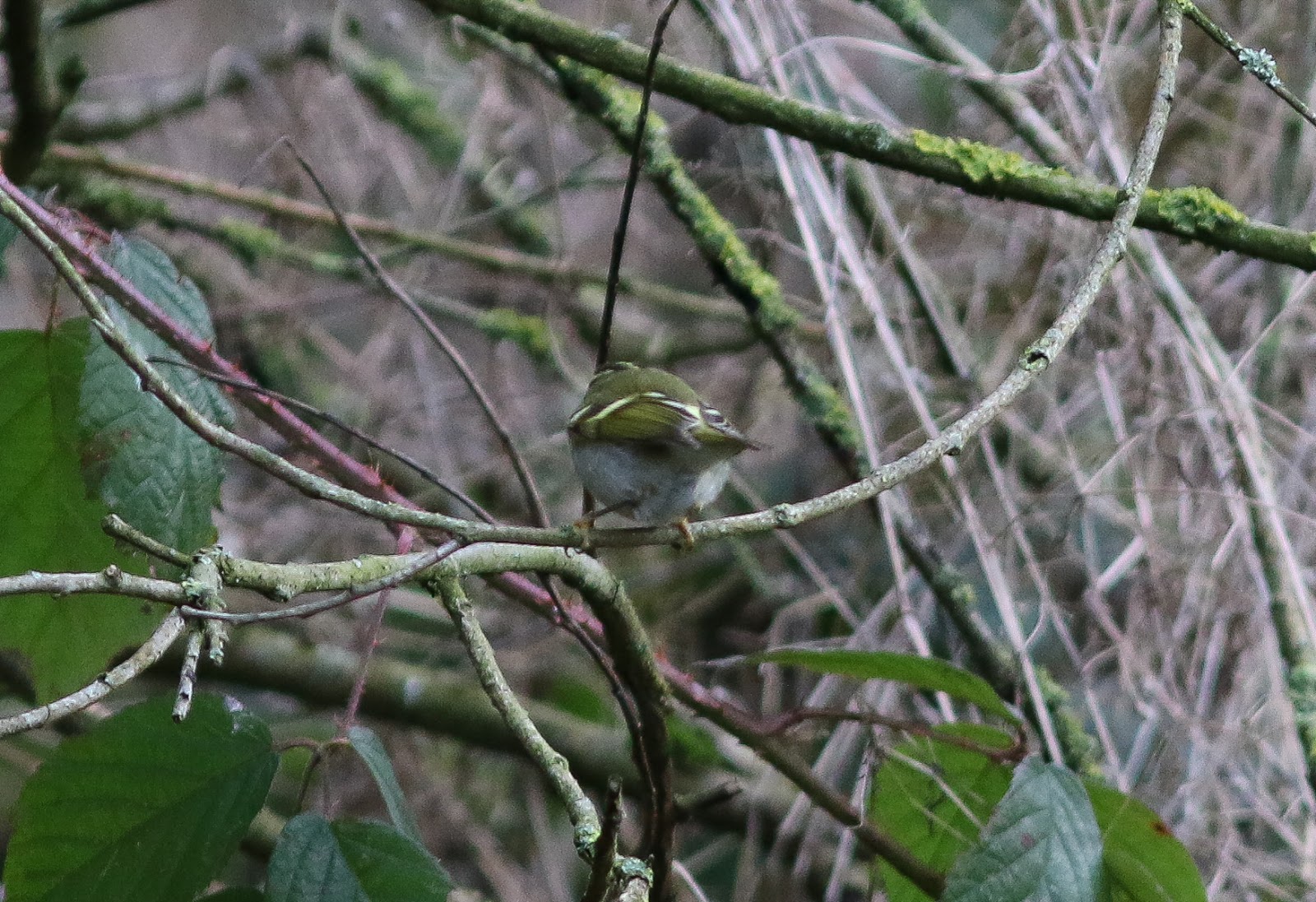
... then just by the base of a pine the Pallas's Warbler popped out and flitted around the low twigs to give lovely views ,,, and even a few record shots ...


... a species that I have seen on all too few occasions in the U.K. but a real delight ...
And a clear High !


Saturday, 26 January 2019

Water Pipit at Boulmer Northumberland ... a rare treat ...

My experience of Water Pipits over the years has been one of brief or distant views of birds ... or birds in tricky terrain where it has been difficult to view the bird because of long vegetation ... not so yesterday at Seaton Point, Boulmer ...

One had been reported there on the 16th January and again on the 24th January ...

The area of beach just to the south of Seaton Point had significant accumulations of seaweed where the top of the beach rose to form a low clay cliff ... the macerated piles of seaweed reminded me of an area at Burton Marsh in Cheshire where a Buff-bellied Pipit lingered a few years ago ...

And sure enough there feeding among the seaweed was a smart bright Water Pipit along with about four petrosus Rock Pipits ...

As we stood on the sand a respectful distance away the birds worked their way closer ...


... the bold white supercillium stood out, emphasized by the dark lores ...


... the leg colour was clearly dark although not actually black ... the contrastingly warm brown of the rump was a constantly visible feature ...


... as the bird turned, the white minimally streaked underparts came into view ...


... and the clear white throat showed up ... and perhaps just a hint of grey beginning to show through on the nape ...


... posing nicely on a pale rock the long bill was more obvious ...


... and turning to show the almost rufous rump ...


sometimes probing among the seaweed and sometimes jumping to catch a fly ...

... and then alternating between the grassy and seaweed areas to feed ...


Tuesday, 22 January 2019

Ring-necked Duck at Tindale Tarn ...

The male Ring-necked Duck that was found on Tindale Tarn at RSPB Geltsdale yesterday was still present today as the early morning light brightened ...

Initially it swam around with its head tucked in ...


... and then bobbed around at the west end of the tarn in the company of some Tufted Ducks ...


... while mostly out of sight from the viewing screen, it did occasionally swim by ...


... then some feeding action in a reed-fringed bay ...


The first Ring-necked Duck for Cumbria was a male at Sunbiggin Tarn on 4-7 April 1982 ; the first female was on 24 April 2007 at Campfield Marsh ...

... with the complexities of returning and wandering birds it becomes difficult to determine the number of 'new' birds that have arrived in the county ... it may well be fewer than ten ...


Friday, 11 January 2019

The Cardurnock Todd's Canada Goose ... and some taxonomic background ...

The Todd's Canada Goose that Nick Franklin found on the north Cumbrian Solway a few weeks ago showed well in the late afternoon sunshine two days ago ...

It was with about 2000 Barnacle Geese but the terrain was favourable ... a flat grassy field with short turf where all the birds remained in view ...


... even when its head was down the dark plainish mantle made it relatively easy to pick out ... compared with feral Canada Goose ( Atlantic Canada Goose - Branta canadensis canadensis ) the pale bars on the mantle appeared finer and more crisp ... the bill was long but slightly less broad based than that of the nominate form ...


... it was considerably larger than the Barnacle Geese ...

After the flock was flushed the birds soon returned but the Todd's looked unsettled for a while ...


... the long thin neck was very apparent ...


The overall appearance of this bird seemed very much in line with individuals of this form B.c.interior that I had seen in the Pilling area of Lancashire on 2 Jan 2017 ...


... and in the Loaningfoot area of Dumfries & Galloway on 1 Oct 2013 ...


Looking back over the years, the early part of the 21st century saw considerable interest in Canada Goose forms and Todd's Canada Goose was discussed in two articles in Birding World in 2001 ...


Then in 2006 Harold Hanson published his monumental work that reflected 50 years of study ...


... this tome along with the one that followed a year later identified 6 species of Canada Goose with the canadensis group consisting of 78 sub-species and the hutchinsii group comprising 84 sub-species ... as the cover photo suggests, the book contains lots of pictures of dead geese and quite a lot of pictures of Canadian bogs - not the lightest of reads !

Today his work seems to be viewed as a step too far ...

The Helm guide of 2014 illustrates some forms including Todd's but the illustration left me feeling not much further forward ...


The excellent work of Sebastien Reeber 2015 gives much detail and highlights some of the ID difficulties particularly regarding the B.c.parvipes form ( confusingly called Lesser Canada Goose despite being part of the canadensis - Canada Goose species rather than the hutchinsii - Cackling Goose species which was formerly known as Lesser Canada Goose ).  He describes parvipes as presenting on of the most difficult ID challenges and interestingly mentions intergradation between Todd's and this form.

The current page on the BBRC website is revealing ...


... so Reeber is the man and we should be thinking interior / parvipes 


Wednesday, 26 December 2018

Geltsdale on Boxing Day ... diverse ducks on the Tarn ... Long-tailed Tits in expanded range ...

As the early morning mist hung in the Tyne Gap a vocal flock of 70 Pink-footed Geese winged their way low over Hallbankgate as they headed eastwards ...

,,, then on Tindale Tarn duck numbers were looking good with some Wigeon swimming out of the reeds by the screen ...


... all now looking very smart ...

... and some of the Teal were close by also ...


A male Pochard lingered among the many Tufted Ducks ...


... and a male Goldeneye showed its eponymous eye well even in the indifferent winter light ...


Along the Howgill Beck towards Howgill a feeding flock of tits was in the Alders and Willows ... several Long-tailed Tits were scattered through this group ...


... presumed to be of the British race A.c.rosaceus they certainly showed a complete lateral crown-stripe and narrow white central crown-stripe ... the shade of the underparts seemed to vary significantly with attitude ... ( a search of images of the central / western race A.e.europaeus showed wide variation with some being remarkably similar to A.e.rosaceus ) ...


The Bird Atlas 2007-11 shows widespread gains in distribution since the previous 1981-84 survey ...


The map below shows the Winter Relative Abundance form the 2007-11 survey and highlights the concentration of the population in the SE of Britain ... the tetrad at Geltsdale is in an area of very low abundance ...


... viewed at Tetrad level this becomes more clear ...


This indication of a range expansion since the 2007-12 survey in Cumbria must show a welcome continuation of the good fortunes of this delightful bird in Britain ...