Monday, 2 April 2018

My birding Week : Solway Scaup ... Garden Bramblings ... Crossbills in true Borderland ...

Scaup has become an increasingly scarce bird on the English side of the Solway.  The Solway Firth is an internationally important wintering site but birds are mainly on the Scottish side.

A few days ago in lovely spring sunshine a pair was off Bowness-on-Solway on the rising tide ...


... meanwhile as a reminder of the changing season a Chiffchaff sang from a nearby ash tree ...

Brambling have been scarce in North Cumbria this winter but two returned to my garden feeders during the week ...


... the male looking very smart ...


... a recent return to the garden after the mid-winter period is Stock Dove ... with up to four birds present at times ...


... Collared Doves are ever present and an early breeding attempt failed as a result of strong winds ...


... and just to complete the trio Woodpigeons often feed alongside the other two species ...


There are at least two pairs of Dunnock in the garden ... their typically cryptic behaviour conceals the complex social structures whereby an individual seeks extra-pair matings while preventing its mate from doing the same ...


... always on the lookout ...

Yesterday in that most northerly extension of Cumbria, Kershope Forest, with Scotland lying just a quarter of a mile to the west and Northumberland half a mile to the east, a few Crossbills fed high in the conifers ...

... never as numerous as the Siskins and Coal Tits that were very active and vocal in the almost sprin-like sunshine, a small group's calls rang out ...

... with only my phone to record them I listened as they gave deep 'excitement calls' and then as the party moved through, birds gave the higher pitched 'flight calls' ...

... the recordings from so high in the trees were barely audible but the sonogram reveals the typical traces of Common Crossbill of the 'British Crossbill' vocal type ...


With winter biting back yet again this morning a pair of Red-legged Partridges found what they could in a sheltered corner of the garden ...


Monday, 26 March 2018

Signs of spring ... a Chiffchaff sings its heart out ... winter migrants on the move, Wigeon and Whooper Swans ... Barn Owls that survived the easterly blast ...

My first summer migrant today ... a Chiffchaff singing constantly this morning from high in a beech tree by Campfield Scrape ... blue skies and barely a breath of wind made it feel much more pleasant than the 2 deg C. air temperature ...


On the Esk above Longtown Rooks were busy by their nests ...


... and several pairs of Oystercatcher looked territorial on the shingle ...


... but no sign of any Sand Martins ...

While on the move a small flock of Wigeon took off ... first against cloud ...


... then into the blue sky ...


... a Greenshank, probably an over wintering bird flew noisily upstream ...


... before turning to fly high overhead ...


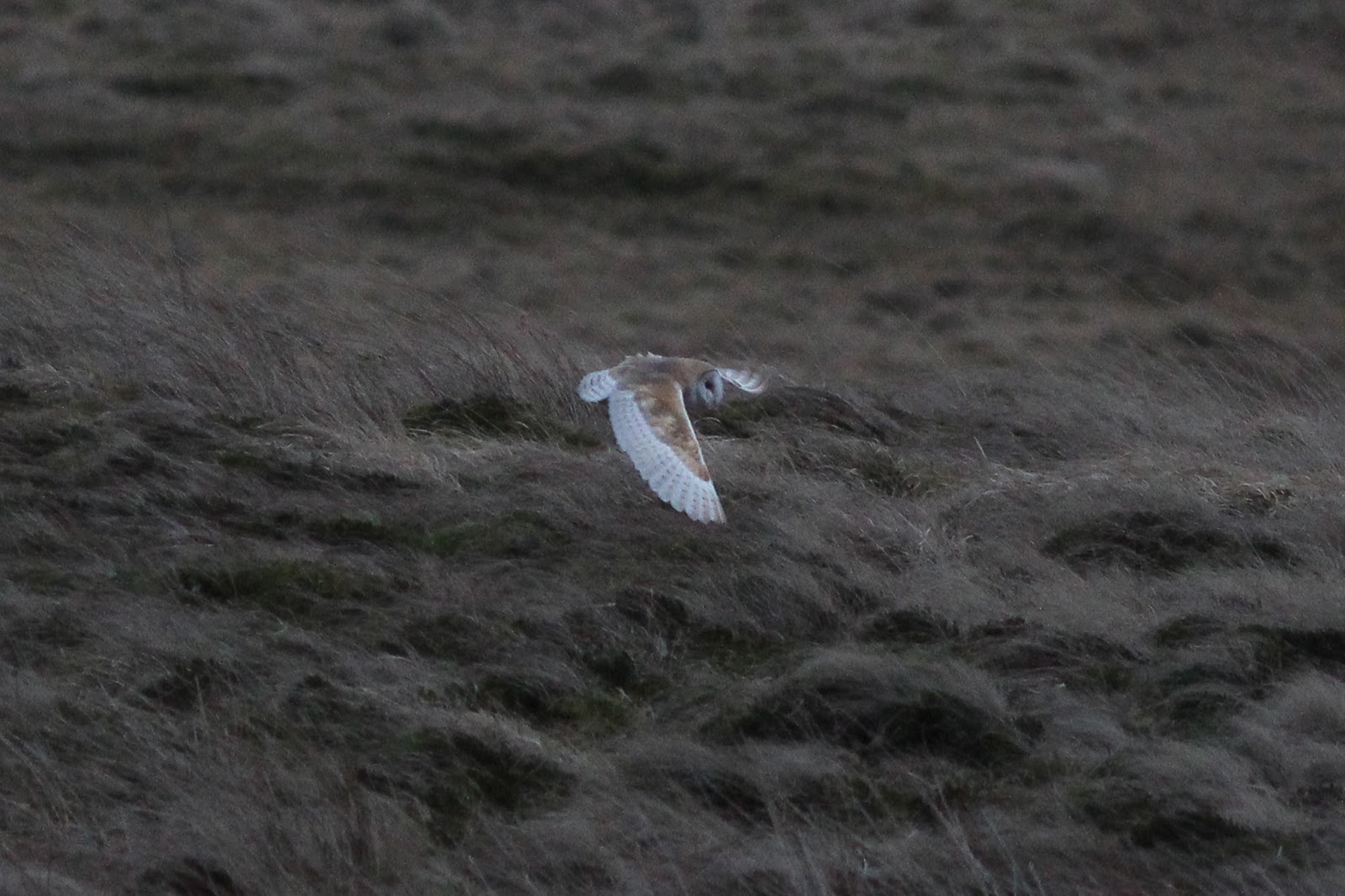
Barn Owls had a hard time at Geltsdale with repeated heavy snowfall resulting in several fatalities but two foraged before sunset last week and seemed to be finding voles ...


The Walby Whooper Swan flock had only a single family party yesterday evening ...


... and the wintering Green Sandpiper showed well on the west pool there as the light faded ..


Tuesday, 20 March 2018

Kleptoparasitism ? ... it's a fine line ... Wigeon feeding opportunistically with Coot at Talkin Tarn ...

My mental image of Wigeon in winter is of quite large flocks sometimes grazing near the water then moving en masse to swim for a while or feeding together in the shallows ... at Grindon Lough this would certainly be typical behaviour

And with Coot I picture them bobbing together in the middle of a lake ... often in quite tight formation ... not particularly associating with other species of waterbird ...

During this winter at Talkin Tarn Wigeon and Coot have associated in small groups scattered widely across the tarn ... and the Wigeon have very clearly been taking the initiative in following the Coot ...


... this Coot looks into the crystal clear water for food ... the Wigeon looks at the Coot ...

Talkin Tarn was quiet and benign this morning with barely a ripple ... not a hint of the ravages of the weather from the last few days ...


... and birds were scattered across its surface ...


... in the foreground a Coot is intent on feeding while a pair of Wigeon wait on ... this same scenario is played out in the background ...


... the Coot dives leaving a circle on the water ... the Wigeon wait ...


... up comes the Coot and for the first time the Wigeon pay attention to the water and the vegetation brought to the surface by the Coot ...


... feeding in progress ...

So the Wigeon are very clearly following Coot, waiting for the Coot to bring food to the surface and joining in on the spoils.

There was no attempt by the Wigeon to actually take food directly from the Coot but they helped themselves to the food the Coot had made available ... is this kleptoparasitism which normally refers to taking food directly from another ? ... well I think it is ... on the human stage this would definitely be called theft ...


... here the Wigeon wait while the Coot gets busy ...


... maybe lean pickings this time ...


... the Coot seeks better foraging and the Wigeon follow ...


... here the spoils allow feeding for all three birds ...

Interestingly the Coot show no sign of aggression towards the Wigeon ...

The literature cites frequent kleptoparasitism on the part of American Wigeon towards a variety of other species ... and Gadwall have been described as having kleptoparasitic relationships with Coot ... the Wigeon Coot relationship seems largely untold ...

On one occasion a male Wigeon swam towards a Coot ...


... whose pose did not indicate foraging ...


... clearly other things were on its mind ...

And with spring in the air all the other birds were looking superb in the hazy sunshine ...


... a Moorhen made a last minute getaway ...

... and with diminishing Wigeon numbers some of the Coot lived unmolested ...


Saturday, 24 February 2018

Swanfest ... Bewick's and Whoopers ... sights and sounds ...

On my third visit to Slimbridge this winter the Bewick's Swans gave nice views as they lingered on the Rushy Pools ... calling gently all the while before flying off onto the more distant and mist enshrouded fields by the Severn Estuary ...


... some left singly and others in twos and small groups from where they had been by the pools ...


... it was interesting to notice the structure of the calls and how they differed from Whooper calls ... the Bewick's having a higher pitched and gentler call with a distinctly musical quality ... each note rising then falling in pitch in a way that reminded me of Eider or Mediterranean Gull calls ...


Bewick's Swan was not recognised by science until 1830, some two years after Thomas Bewick's death ... a number of prominent ornithologists of the day had a hand in establishing the distinction from Whooper Swan and answered the question as to why some 'Wild Swans' were so much smaller than others ... Richard Wingate, a Newcastle taxidermist described the species in 1829 and in 1830 P.J.Selby named it Cygnus Bewickii of Wingate although William Yarrell is credited with being the original describer ...


Woodcut by Thomas Bewick's son.

But the story goes back further ... Bewick's Swan is now recognised as a subspecies of Trumpeter Swan Cygnus columbianus , described by Ord in 1815 but now renamed Cygnus buccinator ... giving credit to the Trumpet concept ( the buccinator muscle in our cheek being used famously by trumpet players ) ...

Interestingly, such nineteenth century commentators such as Saunders and Morris tell us that Bewick's Swan was rare in England but present in Scotland and Ireland in flocks of several hundred ... a striking contrast with today's predominantly south eastern distribution ...

So, with the sights and sounds of Bewick's fresh in the memory, some Whooper Swan experiences were on the cards ... and what better place than Caerlaverock ...


... the birds were in good voice ... and none of the musicality of the Bewick's ... the notes were deep, harsh and lacked the changing pitch ...


The sonograms show the grouping of notes into threes and fours, the constant pitch and low frequency of the Whoopers ...


... and the mainly two note calls of the Bewick's with their charmingly rising and falling notes of a higher pitch ...