Friday, 27 May 2022

France ... a Spring Tour ... some Highlights ...

 The first location was in the southwest near the small town of Septfond ... a quiet spacious campsite set in oak woodland with Golden Oriole, Woodlark, Turtle Dove, Nightingale, Short-toed Treecreeper, Honey-buzzard and Western Bonelli's Warbler ... the lanes around the town had Melodious Warbler, Cirl Bunting, Corn Bunting and a miriad Blackcaps.  

The species that interested me the most was Western Bonelli's Warbler ... these were singing almost constantly from the taller scattered oaks through the campsite ... unlike our own phylloscs they were quite hard to observe ... they sang from the high canopy remaining in one position while looking around ... they would then relocate to another tree before singing again ...


... the song, a repeat of a single note has two subtly different frequencies ... often the fast version is followed by the slow rendition ... the call is upwardly inflected and has a husky timbre ... a really delightful species well worth the effort to observe ...

The next place was on the Mediterranean coast at Gruissan, with its saltpans, etang, and limestone hills ... the wetland areas had hundreds of Flamingoes, many juveniles ...


... and spectacular adults ...


... Black-winged Stilt, Crested Lark, Glossy Ibis, Short-toed Lark, Zitting Cisticola and some apparent intergrade Yellow Wagtails of probable cinereocapilla x iberiae origin ...


... Kentish Plover, a male ...


... and a female ...


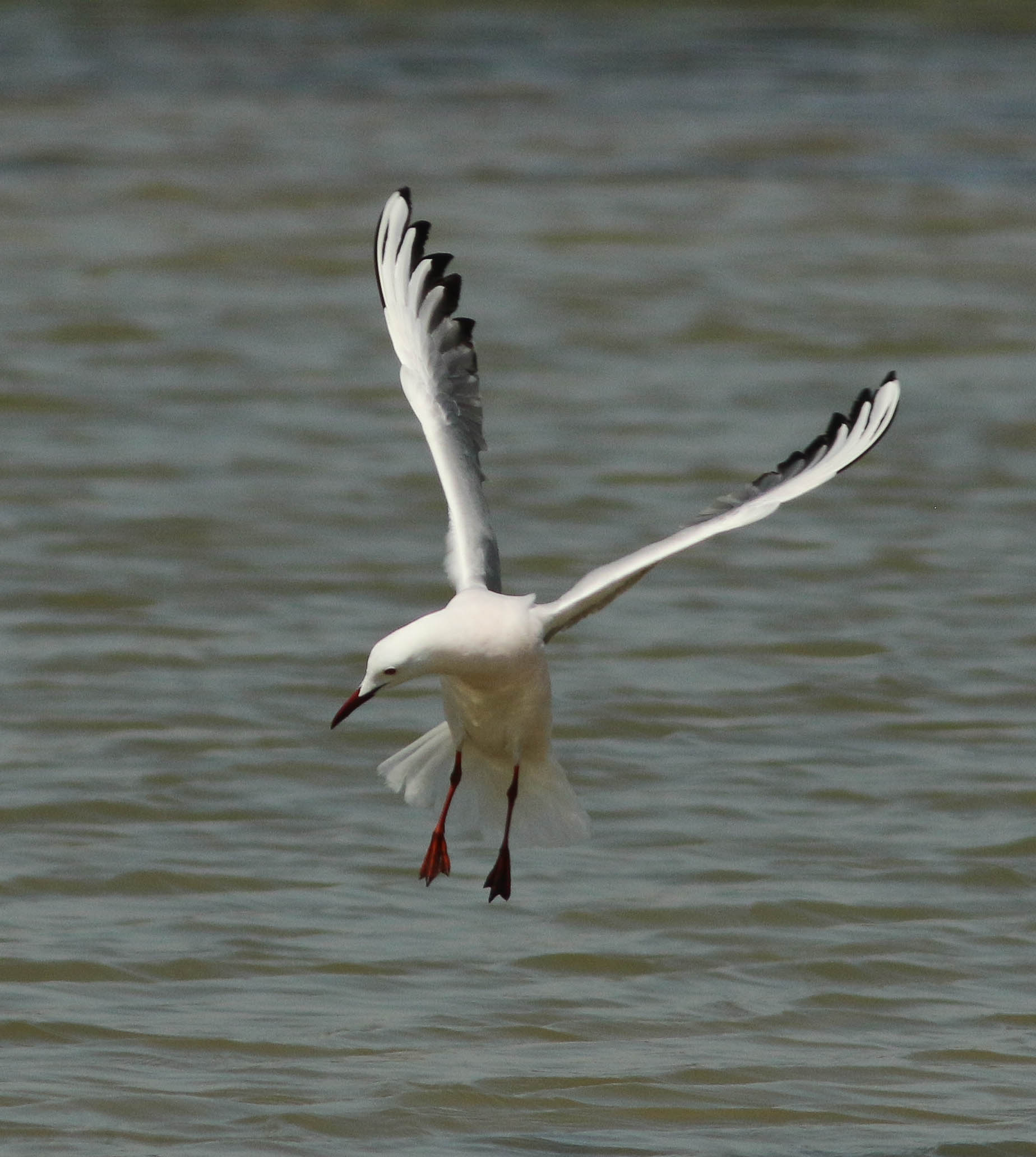
... but the best of all here were Slender-billed Gulls, on the etang, saltpans and some coastal lagoons ... 


... the limestone hills had their own delights with Bee-eaters passing overhead, Tawny Pipit, Southern Grey Shrike and Woodchat Shrike ...


... more warblers in the shape of Dartford and Subalpine and that typical Mediterranean species, Sardinian ...


... Serin, sang from a high branch ...


The Tarn Gorges and adjacent Causses were the next location, just half a day's drive to the north ...

Black Vultures numbered only a few but Griffon Vultures were in the skies in good numbers ...


... while Wryneck called in the scattered woodland where more Western Bonelli's Warblers were scattered and overhead, Black Kite, Goshawk and Short-toed Eagle occupiued the skies ... Crag Martins wizzed around the church ...

The Causse had Ortolan Bunting, Hoopoe, Red-backed Shrike, Chough and a good scattering of Rock Sparrows ...







Tuesday, 26 April 2022

High North Pennines ... the Waders are back ...

 With the snow coming down and blown by a brisk Northeasterly the thermometer read 2 deg C as I headed out yesterday morning ... with visibility around 100m ...

Then the call of a Curlew giving reasons to be optimistic ... and an hour later, now on the high plateau that lovely plaintive call of Golden Plover ... there near the skyline stood the bird ...


... a little later came the song as a few more birds called and flew low, dipping beneath the horizon as they circled by ...

... and then another sound ... the unmistakable song of Dunlin with its slightly crazy quality reeling out across the plateau ...

... and a sharp alarm call ... a quick scan revealed the bird standing quite still and not far away ...


... and there it stood as I walked slowly away to leave it in its wild solitude  


Friday, 22 April 2022

Spring Waders on the Solway

 Late April should be prime time for skuas on the Solway ... however, westerly winds have been inconsistent to say the least.   With a brisk easterly blowing this morning there was little hope of any such action ...

A couple of Whitethroats were in good voice at Port Carlisle but very reluctant to show themselves ... doubtless the chilly wind contributed to that ...

Waders seemed to be rather scarce with low numbers of Redshanks around the harbour but just to the west by the outfall pipe a Whimbrel was feeding ...


With the tide well out at Bowness there seemed to be few birds around ... until distantly way out on the mudflats a group of waders flew in from the west ...


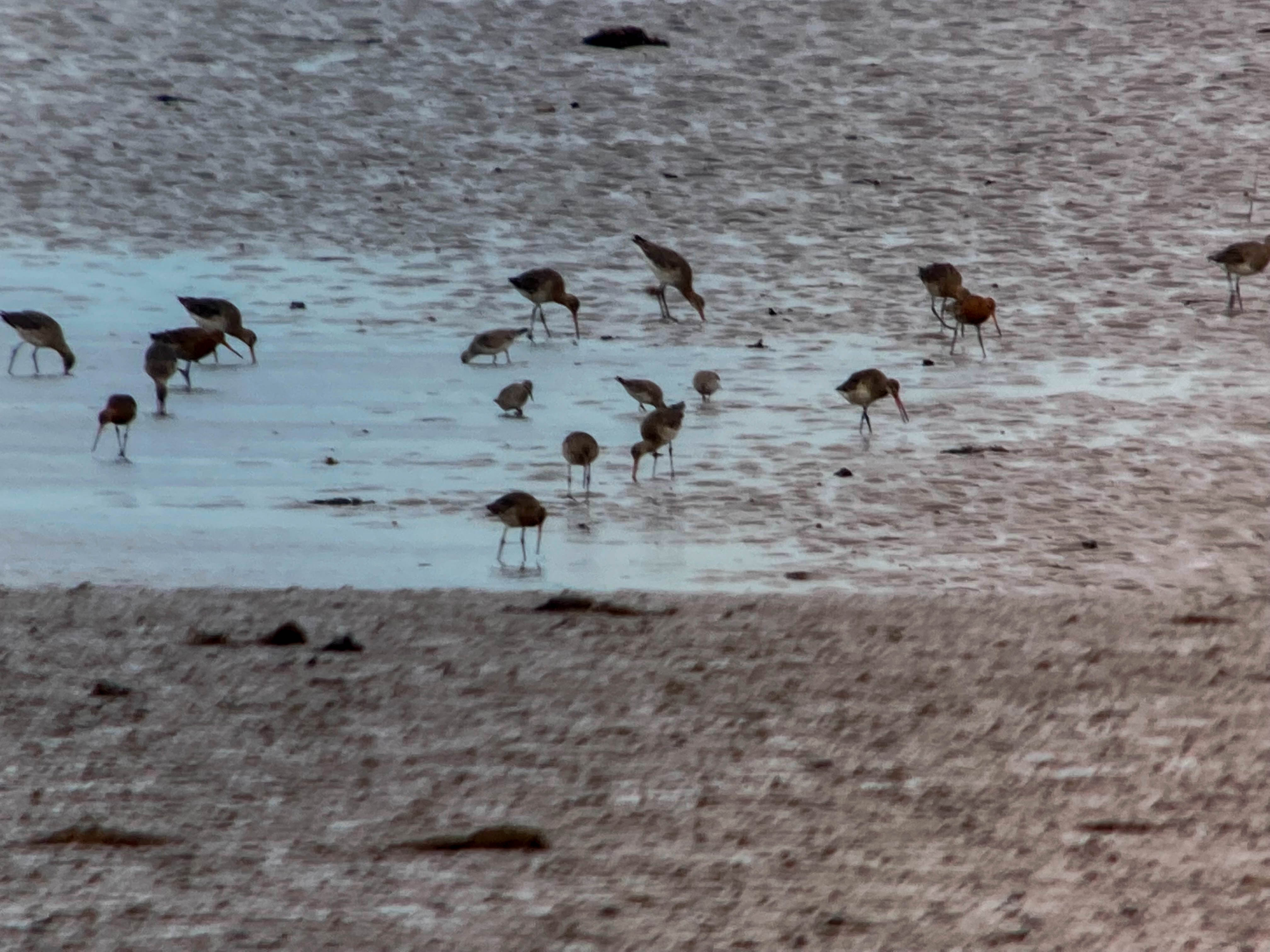
... the flock included 110 Black-tailed Godwits exhibiting a range of plumages from full breeding to birds still in winter plumage ... a small number of Knot were largely still in winter plumage ...


At Campfield Marsh the fields and pools along the lonnen held a good number of Lapwings which no doubt will stand a good chance of having high breeding productivity, protected by the new electric fence ...


... and a very smart male Wheatear fed distantly nearby ...


Sunday, 6 March 2022

Ullapool Gull Update/Correction

 Following helpful comments on the adult gull from Derek Charles and Jamie Partridge it is now clear that this bird was not an Iceland Gull.

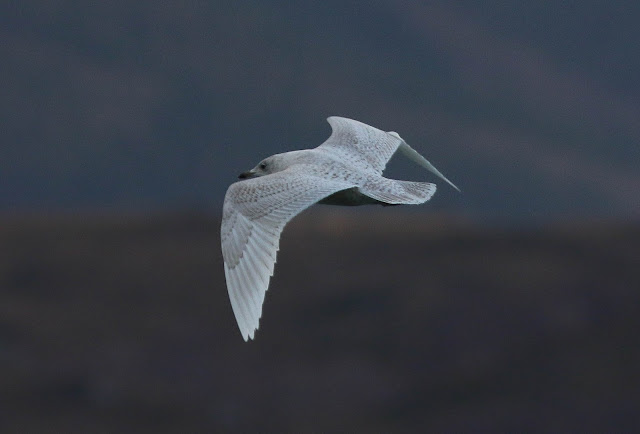
Both Derek and Jamie have visited Iceland and observed hybrid Glaucous x Herring Gulls.  One pointer seems to be the rather slight dark markings on the oiuter primaries as are visible here -


- these markings are apparently variable on these hybrids and can range from almost Herring Gull-like to a few slight grey streaks as shown on this bird.

The long projection of the primaries beyound the tail is apparently typical of this hybrid (aka Viking Gull) and of course differs from the pure Glaucous Gull structure of relatively shorter primaries -


... an instructive bird ! and thanks again for comments Derek and Jamie


Saturday, 5 March 2022

Three days in Ullapool ... in hope of white-wing gulls ...

 Over the years I have seen reports of sometimes large numbers of 'white-wingers' in Ullapool Harbour ... now was the time to seek at least a taste of that ... recent reports were however not encouraging with the last report of Iceland Gull being three days ago and no Glaucous Gull reports within the last week ...

Wednesday afternoon was the first chance to look around the harbour ... there seemed to be very few gulls around in the brisk wind, certainly fewer than ten ... some white primaries were soon apparent on a bird that was flying circuits behind a large boat and occasionally performing a wider circle ...


... a lovely adult Iceland Gull, an age group I rarely see in the North of England ...


... as it circled it gave nice views from time to time although it never perched up ...


The river mouth proved unproductive with only Herring Gulls and a few Great Black-backed Gulls loafing on a shingle bar ...

Thursday morning dawned with the wind less severe and a number of gulls were perched on the ferry terminal ... mostly hunkered down on a concrete slab but one bird was perched up on an exposed mast ...


... the adult Iceland Gull looking magnificent against the dark hillside ... and then performed some circuits of the harbour to give close views ...


... after another unproductive visit to the river mouth I checked it again late in the afternoon and there amoung the Herring Gulls was a juvenile Iceland Gull ...


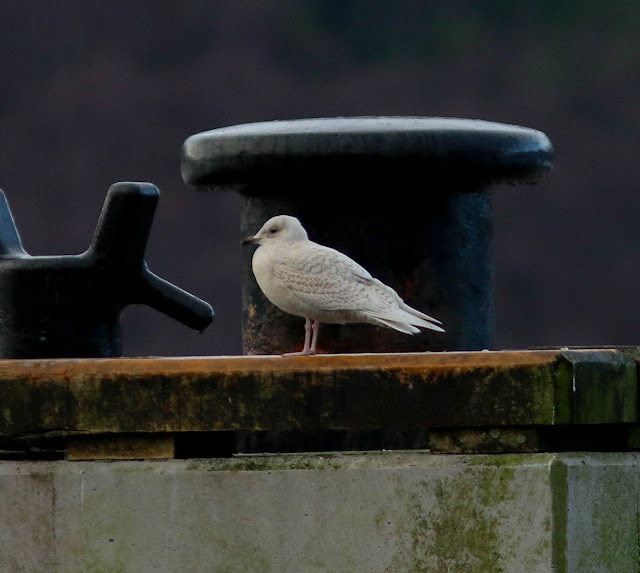
Friday morning saw a very calm Loch Broom and there was a buzz around the harbour with some fishing boat activity .... as I walked past the ferry terminal two gulls were foraging in a waste skip ... one was the juvenile Iceland Gull ... it perched nicely as I viewed it from the entrance to the no-go area of the terminal ...


... it flew off toward the harbour, landing by a capstan ...


... occasionally flying around ...


... superb birds !


Saturday, 1 January 2022

Two female Ring-necked Ducks at Longtown ...

 On 27th December Connor Fraser found a female Ring-necked Duck on the Gretna Road Pool at Longtown ... on 30th December Pete Howard and Adam Moan visited the site and Adam's photograph revealed that there were two females present ...

This site is slightly tricky being on a busy road with a narrow verge ... the views are to the south causing light problems and trees obscure the views ...

I visited this morning hoping to avoid the glare of the sun and Connor was already on site ... along with another birder we located one of the birds through the trees at the east end and then the other some distance away towards the west ...

The bird at the west end showed a complete white band across the bill and a fairly distinct eye-ring and pale line behind the eye ... all good adult features ...


By now the east end bird had swum into a gap in the trees and gave better views ... it had only a small white patch on the bill and less of a distinct face pattern suggesting that it was a first-winter bird ...


This is the first time that two birds have been present in Cumbria together ... it was not until 1982 that the first Cumbria bird was recorded, at Sunbiggin Tarn on 4th-7th April ... what was presumed to be the same male was later seen at Chapel Rigg Tarn and Esthwaite Water over the following month ...

Several more males were recorded through the 1990s with birds often 'touring' local water bodies and also returning to similar locations in subsequent years ..,

It was not until 2007 that a female was seen and this was at Campfield Marsh ... a female was then recorded at Bassenthwaite Lake over the winters of 2007-8 and 2008-9

The next record was also of a female, this time at Siddick Pond in January 2017 ...

A male was recorded at Tindale tarn in January 2019 and spent alsmost two months 'touring' around Talkin Tarn, Castle Carrock Reservoir and some nearby Northumberland sites ...