Monday, 7 May 2018

My Birding Week ... Ring Ouzel, Ruff, Records Panel ... Solway Skuas ...

But first my moment of the week ... not the rarest bird of the week ... nor the least expected ... but the most enchanting ...

... a Wood Warbler singing in Miltonrigg Wood ... with a backdrop of blue skies ... and the emerging leaves fresh and delicate ...


... but going back to the start of the week ...

Monday

The skies were blue as I headed to the uplands of the Geltsdale Reserve ... but the wind was a biting northerly and it felt as cold as any winters day ... now in my 12th year of monitoring / protecting Hen Harriers in the uplands of Cumbria, today was another Harrier day ... with raptor persecution one of the main factors acting against the survival of the now tiny English breeding population, we had not anticipated a further threat coming from a body that ought to be acting in the birds' best interest - Natural England.
With licenses available under the auspices of NE, the Brood Management ( aka Brood Meddling ) plan is a cynical ploy purporting to protect Hen Harriers whereby broods on Grouse Moors can in certain circumstances be moved away until the chicks are well grown and then returned to the uplands.  This is in the interests only of Grouse Moor managers and not in the interests of the Hen Harriers - ( it saves the Grouse Shooting Estates killing the Hen Harriers straight away .. they can do it later when the birds are back in the uplands. )
The upshot of this has been a complete lock-down of information coming from Raptor Workers - secrecy is the only friend of Hen Harriers that are anywhere near to Grouse Moors ...


So with the backdrop of Cold Fell, there were birds that can be mentioned ...

... two Cuckoos sang against each other distantly on the hillside ...


... and ( distantly as ever in this landscape ) a Raven perched on a disclosure post ...


Tuesday

April and May are the prime months for skua passage on the Solway .. so arriving two and a half hours before the high tide I scanned from Bowness-on-Solway as the tide started to come in ... a first-summer male Eider drifted in then flew off out and a pair of Red-breasted Mergansers flew out ... Barnacle Geese were lifting off the westerly Scottish marshes and flying up the estuary ... 


... and just above them two Pomarine Skuas drifting in and circling as they went ... both pale-phase birds ... and as I saw them go out of sight behind trees there were another four birds low over the water - three pale-phase and one dark-phase bird ...

With the tide still rising, some 30 Kittiwakes came in mid-channel and a Red-throated Diver floated by ... and still before the high tide two Great Skuas charged in, well above the horizon and with purposeful flight ...

As the tide pushed waders off the feeding areas, a flock of 45 Whimbrel alighted on the grass to see out the top of the tide ... and a Peregrine circled high over ...

Wednesday

Excited by the skua action, I was ready for more ... but first some woodland birding ... Wood Warblers were singing well in the spring sunshine ... and sometimes 'froze' watchfully ...


... flying to a different song post ...


... and sang again ...


... and a Willow Warbler sang from high up in a bare tree ...


On the Solway the skua movement was less marked than the previous day with only a single pale-phase Pomarine Skua ... although it circled for a while showing off some nice 'spoons' ... and then just one Great Skua ...

... a single Sandwich Tern flew out ...

Thursday

It was the day for the co-ordinated Ring Ouzel count at Geltsdale ... this takes place one hour before sunrise and normally provides rewards in the shape of the sounds of Grasshopper Warblers, drumming Snipe, Black Grouse lekking, Curlews, Lapwings and Cuckoos all eerily coming from the still darkness ...

... not today though ! the wind exceeded the forecast by a good margin ... effectively drowning out all but the closest birds ... as I left the site the sun was just rising ...


With news that the Long-billed Dowitcher has been seen again at Grindon Lough, I headed that way in the afternoon ...
Grindon rarely delivers close views but the Dowitcher was conveniently located in a small gully on the south side ...


... it was not discouraged by the Greylag and Canada Geese it shared the gully with ...


... it demonstrated its typical 'sewing machine' feeding action ...


The birding day was not yet over with the Cumbria Bird Club Records Panel meeting in the evening ... having just taken over as County Recorder in October this was my first event as Chairman of the Panel ... it went well and everyone got along ... phew !

Friday

On the Budge Pool at Druridge a smart male Garganey swam briefly into the open from its preferred location among the vegetation ...
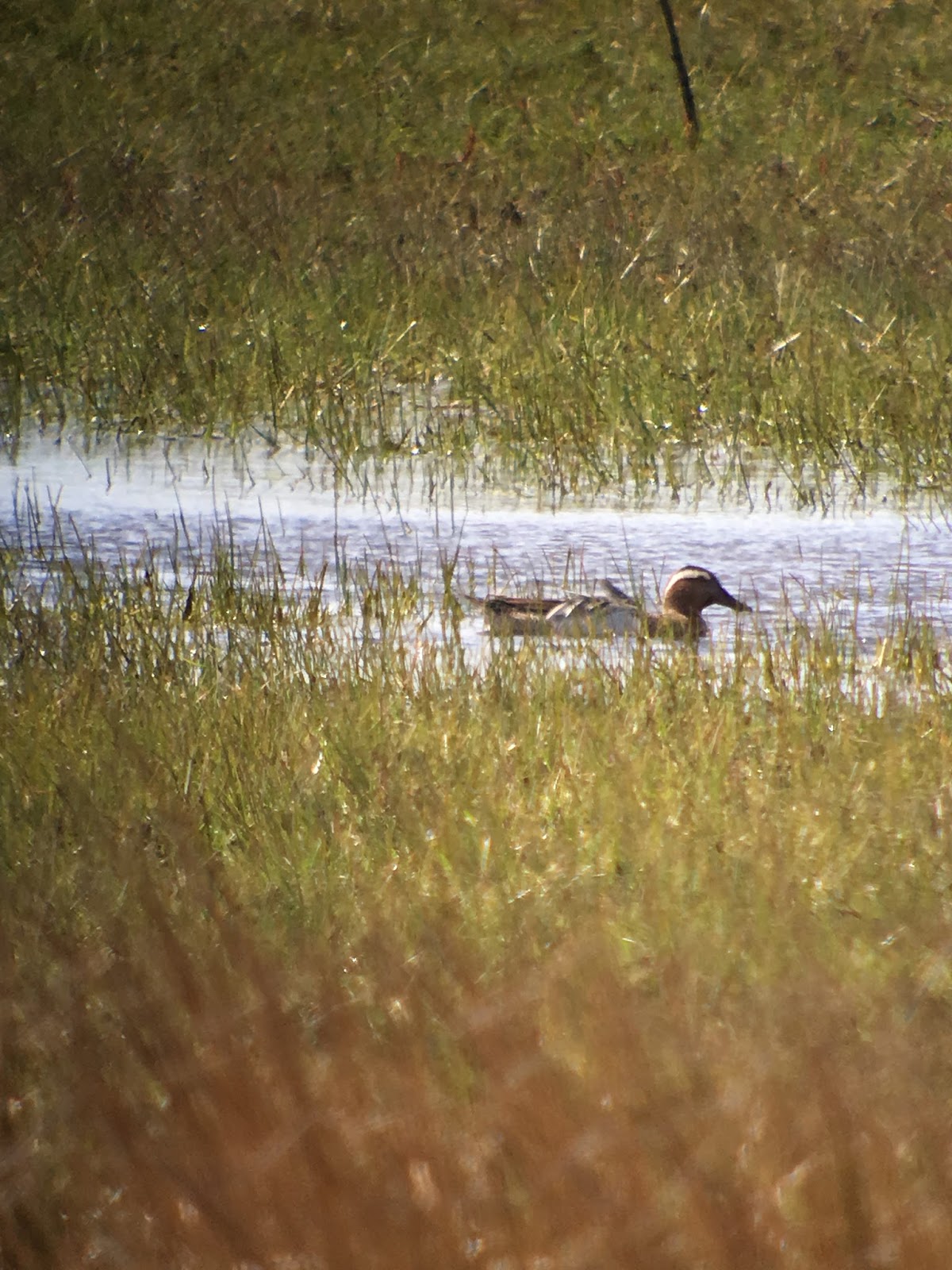

... and way over on the far side a striking male Ruff wandered across a gap in the rushes, followed by a female ...


... and on the main pool a Glossy Ibis preened ...


... and a breeding plumage Black-necked Grebe surfaced from time to time in less than predictable fashion ...


... by the farm buildings the regular Little Owl occupied one of its usual spots ...


... Sedge Warblers were aplenty ...


... and at East Chevington a flock of twenty or so Whimbrel fed in the long grass ...


 and flew circuits occasionally ...


Then passing by Grindon Lough for another look at the Long-billed Dowitcher ...


... still keeping the same implausible company ...


Thursday, 26 April 2018

A quiet week in Norfolk ... Brent Geese and summer migrants ...

Numbers of Dark-bellied Brent Geese were still impressive last week on the North Norfolk saltmarshes ...


... the birds seemed to be constantly on the move ... sometimes swimming and bathing in the channels ...


... then lifting to form great wheeling masses in the sky ...


 ... first flying westward only to return eastwards only minutes later as I stood on the edge of the saltmarsh at Morston ... they flew close by each time with no apparent avoidance of humans ...


... and yet more distant flocks towards Stiffkey ...


... along side that seemingly wintry scene Avocets were engrossed in breeding behaviour ... this group of four acting as a unit within which the pairing was perhaps not yet settled ...


... and this male fed in the nearby channel ...


Marsh Harriers were ever present ... a female settled distantly near Stiffkey Fen ...


... and Red Kites seemed much more common than in recent years ...


... a few Little Ringed Plovers were scattered around the Cley marshes along side some Dunlin and Black-tailed Godwits ...


... suddenly 19 Ruff flew in to add to the already present handfull of Ruff ...


... with some lovely looking individuals ...


... a small group of Turnstones on Blakeney Point rested on the shingle ...


... in the reed beds Bearded Tits were very scarce, perhaps the result of a hard winter ... as the week wore on increasing numbers of Sedge Warblers sang from the reeds and brambles on Blakeney fresh marsh ...

Shovelers were widely distributed with some very showy birds ...


... and Egyptian Geese strutted their stuff ...


... or at least the males did ...


... while a flock of Pochard whiled away the afternoon on an increasingly choppy stretch of water ...


... with the grebes keeping to the more sheltered areas ...


... and on a tranquil evening a smart male Gadwall drifted among the reeds as the breeze barely rippled the surface ...


Tuesday, 10 April 2018

Brent Geese and a Black Brant in south Cumbria ... further insights ...

Following a number of reports of a Black Brant in the Walney Channel in Barrow I visited the area last week ... there were only about fifteen Pale-bellied Brents present so I relocated to the Roa Island causeway just about four miles to the south east ...

As the tide rose around forty Dark-bellied Brent Geese fed on the water's edge to the east of the causeway ... sometimes swimming in the shallows ... and with them, a Black Brant ...


... the appearance of the Brant puzzled me slightly in terms of some of its features ... while it was distinct from the Brents it looked rather different from the Brants that I had previously seen in Norfolk over the years ... the white neck collar seemed less bold and the white flank markings looked less intensely white and was interrupted by greyish bars ... structurally the neck was less obviously thicker than those of the Brents although the forehead was more domed ( as it should be ) in comparison with the Brents ...


... here some Brents feed together, the changing attitudes of the birds giving them ever changing colour tones in the weak sunshine ...


But alongside the Brents, the Black Brant is distinct ...


... here the head shape looks distinctive as the Brant swims behind a Brent ...


... and some video-grabs as the Brant leaves the water ...


Here is a small group of Pale-bellied Brents in the Walney Channel at Barrow ...


... and on the rising tide a flock of around eighty flew in distantly on the west side of the causeway before departing towards Walney Island ...


Still puzzled by what I took to be the atypical appearance of the Brant I checked previous images of the bird taken by others ... it was clearly the same individual ... the niggling doubt that I had was around the purity of the bird ... could it be a hybrid ? ... it strongly reminded me of Black Brant x Dark-bellied Brent hybrids that I saw in Norfolk some years ago ...

I consulted Andy Stoddart on this.

Andy writes -
The key feature to look for would be the presence of dark earth-brown hues (as opposed to grey) in the upperparts and breast ... The flanks and neck collar look to be within the range of variation of Black Brant and the breast/belly contrast looks suitably minimal so, unless the bird was strongly grey-hued, I wouldn't necessarily call it a hybrid based on your images.
Ends.

... having checked further images, the colour tones concerned showed dark brown rather than grey ... and with concerns around the neck collar and flanks allayed, thoughts of hybrid origin faded ...

... a very useful learning experience ... I'm grateful to Andy for his input ...

Interestingly a couple of taxonomic quirks came to light as I was reading around the Brent Goose complex -
- the name Brent is apparently a corruption of Brant and was introduced erroneously by Pennant in the 1800s
- Black Brant originally Branta bernicla nigricans became B.b.orientalis when it was discovered that the type specimen was not a Black Brant but a Grey-bellied Brent which thus acquired the scientific name B.b.nigricans

There have been those who advocated splitting the races of Brent Goose (including Black Brant ) into three of four species but the current IOC position keeps then as a single species.